
In brief
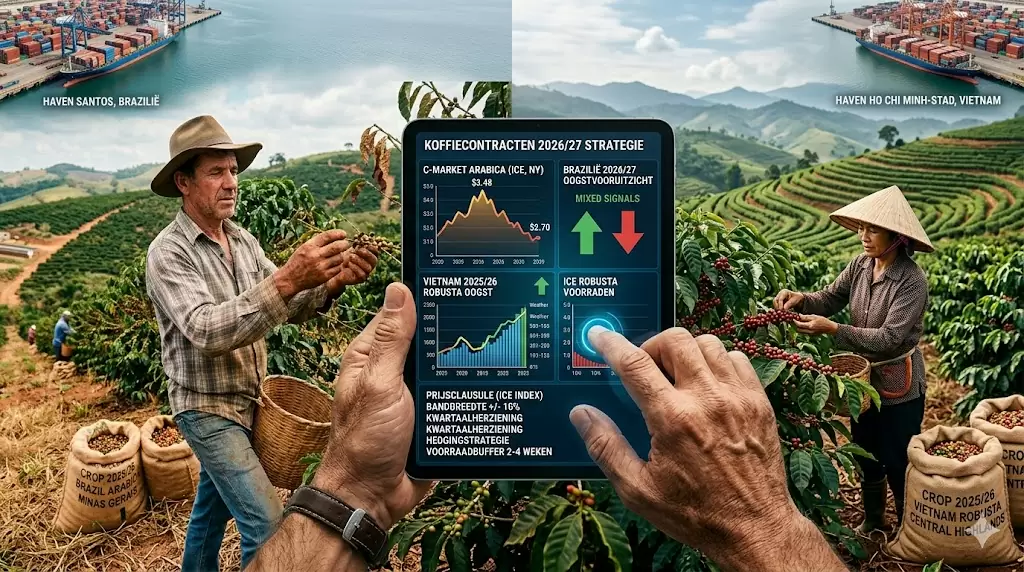
Drought in Brazil and flooding in Vietnam are shaping the 2026 coffee harvest and directly affecting supply security and purchasing terms for B2B customers. The market remains volatile, but those who evaluate contract clauses and inventory buffers now will be in a stronger position.
- The 2025/26 Brazilian Arabica crop was 2.9 million bags lower than the USDA forecast due to prolonged drought in Minas Gerais and São Paulo.
- Vietnam is recovering gradually: the USDA estimates production for the 2025/26 season at 30.8 million bags, about 6% higher than last season.
- ICE Robusta stocks are at their lowest level in over a year, which is limiting downward pressure on Robusta prices
- A price clause linked to the ICE quote, with quarterly adjustments and a range of plus or minus 10%, distributes market risk fairly.
Drought in Brazil and heavy rainfall in Vietnam are putting pressure on the 2026 coffee harvest in Brazil and Vietnam. For buyers, this directly affects purchase prices, supply security, and negotiating leverage. Below you will find specific climate data, its translation into C-market prices across three 2026 market scenarios, and guidance for your contract strategy.
Climate-related damage to Arabica coffee in Brazil
Brazil accounts for about 40% of global coffee production. The 2025/26 Arabica harvest was significantly lower than expected. According to the USDA (United States Department of Agriculture, the U.S. agricultural agency that publishes global harvest estimates), production fell to 38 million 60-kg bags, while the forecast had been 40.9 million bags. Prolonged drought during the flowering period in Minas Gerais and São Paulo was the direct cause.
Flowering determines fruit set. A lack of rainfall led to lower yields per hectare and a below-average conversion rate (the ratio of harvested cherries to export-ready green beans) from cherry to green bean. Frost and high temperatures in February 2025 caused additional stress to young plantings. Minas Gerais reported an 11% drop in harvest volume compared to the previous season.
The outlook for the 2026/27 harvest is mixed. Recent rainfall has improved the outlook, and analysts estimate the combined Brazilian harvest at 70 to 75 million bags. That forecast depends entirely on stable weather in the coming months.

Robusta in Vietnam: Floods and a Cautious Recovery
Vietnam is the world’s largest producer of Robusta coffee and supplies the vast majority of Robusta for the European market. The 2025/26 harvest was severely affected by Typhoon Yagi and Tropical Storm Trami, which hit the Central Highlands with extreme rainfall of more than 160 millimeters in a short period of time. This damaged ripe cherries, disrupted the harvest, and reduced quality.
The outlook for 2025/26 is better. The USDA estimates Vietnamese production at 30.8 million bags, about 6% higher than last season. Farmers are responding to record-high local prices. Still, the risk of new weather extremes remains real. The Central Highlands, responsible for more than 70% of Vietnamese output, are vulnerable to both drought and monsoon rains.
Coffee C-market price in 2026: three scenarios
The C-market is the international futures exchange (ICE) where Arabica futures are traded and which serves as the benchmark price for the majority of global coffee contracts. The C-market price for Arabica peaked in January 2025 at around $3.48 per pound, a 79% increase from the previous year. In early 2026, the price dropped to approximately $2.70 per pound due to expectations of a larger Brazilian harvest. The World Bank projects a 13% decline for Arabica in 2026 and another 5% in 2027.
The direction of Arabica and Robusta prices depends on which market scenario unfolds.
ICE Robusta stocks are at their lowest level in over a year, making the bearish scenario for Robusta less likely.
For buyers, the following applies: falling futures prices do not immediately translate into lower purchase prices, because suppliers first deliver stock that was purchased earlier at higher prices.
Contract Strategy for Your B2B Coffee Contract
Suppliers counter price pressure in various ways. Some use variable pricing clauses linked to the C-market, while others apply fixed quarterly prices with a review date. Two rules of thumb can help with contract renewal in 2026. Link your price clause to a recognized index such as the ICE quote, with a fixed range of, for example, plus or minus 10% and a quarterly review. This way, you share the risk fairly. In times of high volatility, opt for a contract length of six to twelve months with an interim review, rather than a one-year contract without an escape clause.
Ask your supplier how far in advance they have purchased green coffee. A supplier who hedges six months in advance (purchasing in advance on the futures market to hedge against price risk) offers greater price stability than a supplier who buys on the spot market. In addition, build in a stock buffer. Those who purchase entirely on a just-in-time basis are vulnerable to delivery delays caused by disruptions at ports such as Santos or Ho Chi Minh City. In an upward market scenario, a buffer of two to four weeks of extra stock protects against acute price spikes.
The 2026 coffee harvest in Brazil and Vietnam will continue to be a key factor in determining the commercial coffee price this year. Those who evaluate their contract terms, price clauses, and inventory buffers now will be in a stronger position when the next price fluctuation occurs.

Frequently Asked Questions
How does the drought in Brazil affect my current coffee contract?
Lower Brazilian harvests are driving up the C-market price. If your contract includes a variable price clause, your purchase price will rise accordingly. With a fixed-price contract, your supplier bears the risk, but you can expect a higher base price upon renewal. Check now to see what type of clause you have and when the price is reviewed.
Can a B2B supplier guarantee fixed prices despite market pressures?
That depends on the hedging strategy. Suppliers who purchase green coffee in advance on the futures market can offer fixed prices for a limited time. Always ask how far in advance the green coffee was purchased and what review dates are specified in the contract.
What is a transparent pricing clause for a coffee contract in 2026?
A good clause links the price to a recognized index, such as the ICE index, with a range of plus or minus 10% and quarterly adjustments. This helps prevent unexpected price spikes and ensures that market risk is shared fairly.
Which countries produce the coffee that Dutch companies purchase?
Brazil and Vietnam are the two largest suppliers. Brazil dominates the Arabica market, accounting for approximately 40% of global production. Vietnam is the largest Robusta producer. Colombia, Ethiopia, and Honduras are other major sources for the Dutch market.
How can I protect my business from delivery delays caused by climate-related damage?
Build in a two- to four-week buffer, especially in a rising market scenario. Ask your supplier about their purchasing position and opt for a contract term of six to twelve months with a mid-term review. Relying entirely on just-in-time purchasing leaves you vulnerable to disruptions at ports such as Santos or Ho Chi Minh City.

Want to make the best coffee at work?
Discover our commercial coffee machines with an all-inclusive subscription, or schedule a no-obligation trial appointment at our showroom.